Diplotaxis honey
- Scientific name
- Diplotaxis spp
- Regions
- North and Central Tunisia (Cap Bon, Tunisian Dorsale, olive groves and wastelands)
- Harvest month
- Mars
- April
- Mai
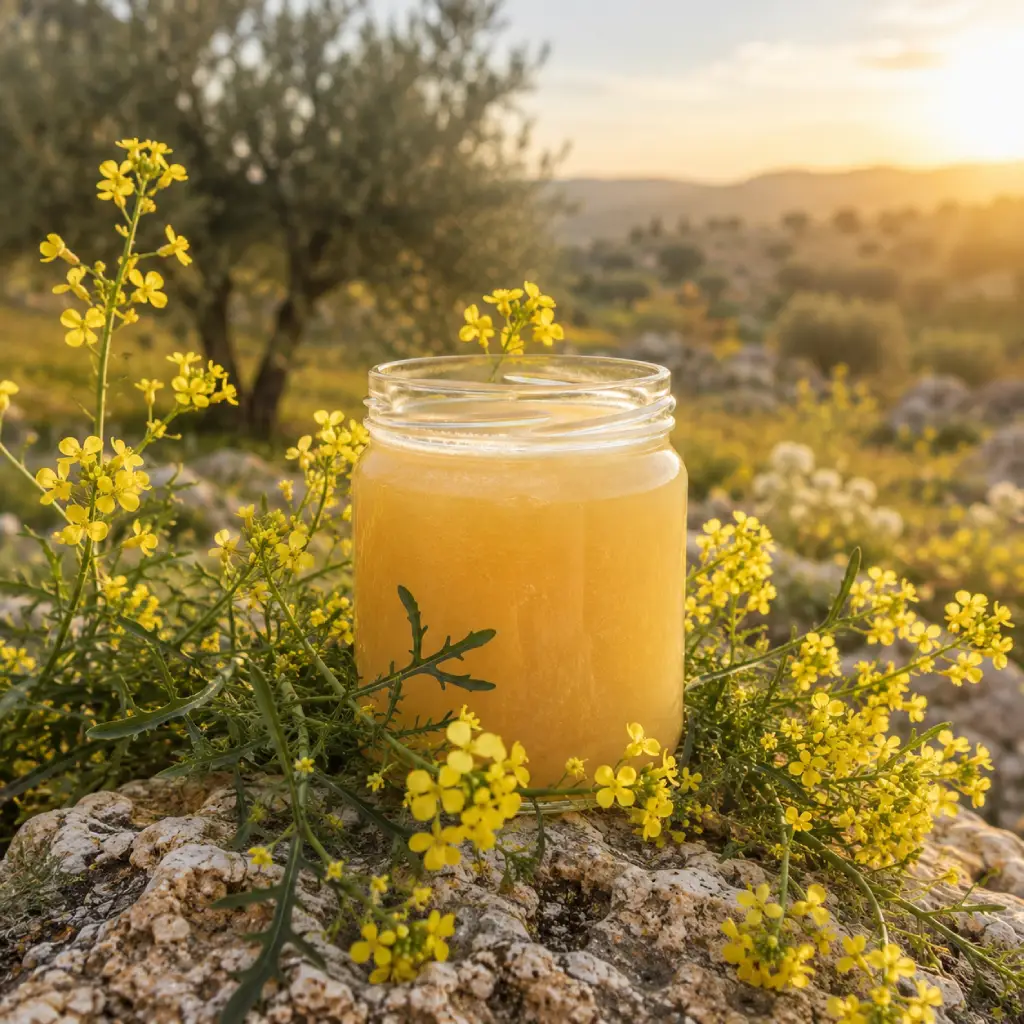
Diplotaxis honey is a rare floral honey produced by bees using the nectar from flowers of plants belonging to the botanical genus Diplotaxis. In Tunisia, it is generally sold under the name wild rocket honey or عسل الجرجير. This name mainly refers to wild rockets that grow spontaneously in fields, grazing areas, fallow land, and agricultural spaces.
It should not automatically be equated with honey from cultivated rocket, Eruca sativa. Plants locally referred to by the names جرجير, جرجيرة, or الحارة may belong to several closely related species within the Brassicaceae family. In the absence of precise botanical identification or a pollen analysis of the honey, the most cautious scientific name therefore remains honey of Diplotaxis spp.
عسل الجرجير
Depending on regions and local uses, the plant may also be called جرجيرة or الحارة. However, these common names may refer to different wild rockets and, on their own, do not allow identifying a single unique botanical species.
Miel de Diplotaxis
The name miel de roquette sauvage can also be understood by the general public. The term "Diplotaxis honey," however, is more precise when it is not possible to determine the exact species of plants visited by the bees.
Diplotaxis honey
The names wild rocket honey or wild arugula honey may also be used in a more general, popular context.
The genus Diplotaxis belongs to the Brassicaceae family, which includes, among others, mustards, cabbages, turnips, and various types of rocket. It comprises annual or perennial herbaceous plants, often adapted to Mediterranean environments that are dry or disturbed.
Several Diplotaxis species grow spontaneously in Tunisia. Among the species reported in Tunisian flora are, in particular :
- Diplotaxis erucoides (L.) DC. ;
- Diplotaxis muralis (L.) DC. ;
- Diplotaxis simplex (Viv.) Spreng. ;
- Diplotaxis virgata (Cav.) DC. ;
- other species or subspecies of the genus Diplotaxis, depending on the regions and habitats.
This botanical diversity means that honey sold under the name Diplotaxis honey does not necessarily come from a single species everywhere in Tunisia. Its dominant source may vary according to the harvesting region, local vegetation, and the flowering period.
Diplotaxis species are commonly considered wild rockets. They develop small flowers, usually yellow, pale yellow, white, or slightly pinkish depending on the species. Their open and relatively accessible flowers can provide nectar and pollen to different pollinating insects.
Some Diplotaxis species strongly attract bees. Research on plants favorable to pollinators has observed frequent visits of Diplotaxis tenuifolia and Diplotaxis erucoides by honeybees and other pollinating insects.
In Tunisia, Diplotaxis species often grow spontaneously in fields, olive groves, orchards, along paths, on fallow land, and in agricultural areas that are less treated. Their natural presence can, in favorable years, create sufficiently abundant blooms to be exploited by bee colonies.
Diplotaxis honey is marketed by Tunisian beekeepers, but the exact production areas are still insufficiently documented in accessible publications. Its harvest is likely linked to regions where wild rockets form abundant stands near the apiaries.
It is therefore best to avoid attributing this honey to a single Tunisian region without knowing the location of the apiary or the information provided by the producer. For each harvest, the region, district, the apiary environment, and the flowering period should ideally be recorded.
The flowering period varies depending on the species, region, rainfall, and temperatures. Under Mediterranean conditions, wild rockets can bloom during the cooler, wetter seasons, mainly from autumn to spring.
Some species take advantage of the first autumn rains, while others show a more pronounced flowering in winter or at the beginning of spring. Therefore, honey harvesting depends strongly on the year's climatic conditions and on the actual abundance of flowers around the apiary.
A rainy year can encourage an extended flowering, while prolonged drought can greatly reduce the availability of nectar. Diplotaxis honey can thus be irregular and rarer than honeys from crops or more stable melliferous stands.
Diplotaxis honey may be presented as single-flower honey when Diplotaxis nectar is the dominant floral resource in the harvest. This does not mean that bees did not visit any other plants, but rather that the honey's botanical and sensory profile is mainly associated with this source.
In the absence of melissopalynological analysis, the single-flower origin should nevertheless be considered as an indication provided by the beekeeper, based on observations of the dominant blooming and the location of the hives.
When several Brassicaceae species or other melliferous plants bloom simultaneously, the product can be more accurately described as multifloral honey with Diplotaxis as the dominant source.
Color
Tunisian commercial descriptions generally present wild rocket honey as very light-colored, which can turn whitish or creamy white after crystallization.
However, this characteristic should not be considered universal. The actual color may vary depending on the dominant Diplotaxis species, the other nectars present, the crystallization stage, the season, and storage conditions.
Texture
It may have a liquid texture immediately after extraction, then quickly become creamy or finely crystallized. Products sold in Tunisia are frequently described as creamy honeys with a light texture.
Crystallization
Diplotaxis honey is often presented as honey with rapid crystallization. It can form a light, soft, and creamy mass when crystallization is fine and homogeneous.
Crystallization is a natural phenomenon. It does not mean that the honey has been altered or that it contains added sugar. Its speed mainly depends on the ratio of glucose to fructose, the water content, the storage temperature, and the presence of natural particles that act as crystallization nuclei.
Aroma
Its scent is generally described as light, vegetal, and floral. Some producers mention an odor reminiscent of rocket flowers. However, the aromatic intensity can vary noticeably from one harvest to another.
Taste
The taste can be mild, vegetal, and slightly characteristic of plants from the Brassicaceae family. Depending on the harvest, a grassy note, slightly sharp, or discreetly mustard-like nuance may be perceived.
These notes should be presented as sensory tendencies rather than as an official profile definitively established, because comparative data on Tunisian Diplotaxis honey remain very limited.
Diplotaxis honey is considered relatively rare. Its production depends on a sufficiently dense spontaneous flowering, favorable weather, and the presence of strong colonies at the time when the flowers secrete nectar.
Unlike a large, managed melliferous crop, a wild population of Diplotaxis may be abundant one year and much less present the following year. Grazing, plowing, weeding, the use of herbicides, drought, or changes in land use can also reduce the available flowering areas.
Cultivated rocket, generally identified as Eruca sativa, also belongs to the Brassicaceae family, but it is not part of the genus Diplotaxis.
In Tunisia, the plant underlying عسل الجرجير seems more likely to correspond to one or more wild rockets than to large-scale Eruca sativa crops. The name "rocket honey" may therefore be correct in everyday language, but it remains botanically imprecise.
For rigorous documentation, it is recommended to distinguish :
- honey from cultivated rocket, coming mainly from Eruca sativa ;
- honey from wild rocket, coming from one or more species of Diplotaxis ;
- multifloral honey in which Brassicaceae pollen is important without a single-flower origin being demonstrated.
The recommended scientific name for the general profile is :
Diplotaxis spp.
The abbreviation "spp." indicates that several species within the same genus may be involved, or that the exact species has not yet been identified.
It would be premature to systematically use Diplotaxis tenuifolia as the scientific name for Tunisian honey. This species is known as a perennial wild rocket in several regions of the world, and it is attractive to pollinators; however, currently available data do not demonstrate that it is the main source of all Tunisian honeys sold under the name عسل الجرجير.
A more precise identification would require knowing the plants present around the apiary and, ideally, conducting a pollen analysis of the honey.
Melissopalynology consists of studying the pollen grains contained in honey. It helps to better understand the plants visited by bees and to assess the probable botanical and geographical origin of a harvest.
In the case of Diplotaxis honey, analysis can nevertheless be complex. Pollen from plants belonging to the Brassicaceae family may show morphological similarities and are not always identifiable with certainty down to the species level.
Authentication should therefore combine several elements :
- botanical observation around the apiary ;
- the actual flowering period ;
- the movement and harvesting calendar of the hives ;
- pollen analysis ;
- the honey's physico-chemical characteristics ;
- sensory analysis ;
- possibly molecular methods such as DNA metabarcoding.
Like other natural honeys, Diplotaxis honey consists mainly of naturally present sugars, particularly fructose and glucose. It also contains water, organic acids, enzymes, aromatic compounds, minerals, and various phenolic compounds in varying quantities.
Its precise composition depends on its actual botanical origin, the region, climatic conditions, the honey's maturity at the time of harvest, and storage practices.
The general properties of honey do not automatically allow attributing specific therapeutic effects to Diplotaxis honey. Claims regarding fertility, hormones, anemia, diabetes, or cancer, sometimes found in commercial advertisements, should not be repeated as medical facts in the absence of specific and sufficiently robust clinical studies.
Diplotaxis honey can be consumed as table honey, on bread, with dairy products, in lukewarm drinks, or in various culinary preparations.
Its creamy texture and light color can make it especially suitable for toast, breakfasts, and comparative tastings of Tunisian honeys.
To best preserve its aromas, it is preferable not to expose it to excessive heat for an extended period.
Honey should be stored in a clean container with an airtight seal, away from moisture, direct light, and large temperature fluctuations.
A moderate, stable temperature generally helps preserve its qualities. If it crystallizes, it can be eaten as is. To make it temporarily more fluid, the jar can be placed in a lukewarm water bath, without overheating.
Honey should not be given to children under twelve months of age due to the risk of infant botulism.
People who are allergic to beehive products or certain pollens should remain cautious. Honey is also a food rich in sugars and should be consumed in moderation, particularly as part of a diet requiring carbohydrate intake control.
Wild rockets contribute to the floral diversity of Mediterranean agricultural landscapes. When preserved on fallow land, field margins, orchards, and olive groves, they can provide nectar and pollen to honeybees as well as to various wild pollinators.
Preserving these spontaneous plants helps maintain diverse food resources for insects. Therefore, agricultural management that limits treatments during flowering and preserves certain strips of vegetation can support both biodiversity and local apiculture.
Diplotaxis honey illustrates the importance of documenting the vernacular names used by Tunisian beekeepers. The name عسل الجرجير corresponds to a commercial and apicultural reality, but its exact botanical origin can vary depending on the territories.
Additional research would be needed to determine :
- which Diplotaxis species are mainly exploited by bees in Tunisia ;
- the main production regions ;
- the harvesting periods ;
- the characteristic pollen spectrum ;
- the typical color, aroma, and crystallization ;
- the physico-chemical characteristics that make authentication possible ;
- variations among different harvests and Tunisian regions.
While awaiting these studies, it is better to present Diplotaxis honey as a rare Tunisian honey mainly derived from wild rockets, while noting that the exact botanical species and the official criteria for characterization still need to be specified.
- French name : Miel de Diplotaxis
- Common name : Wild rocket honey
- Arabic name : عسل الجرجير
- Other local names : عسل الجرجيرة، عسل الحارة
- English name : Diplotaxis honey / Wild rocket honey
- Botanical origin : Diplotaxis spp.
- Botanical family : Brassicaceae
- Type : potentially single-flower floral honey
- Main environment : spontaneous flora, fallow land, and Mediterranean agricultural spaces
- Documentary status : honey evidenced in Tunisian apicultural trade, but still insufficiently characterized scientifically
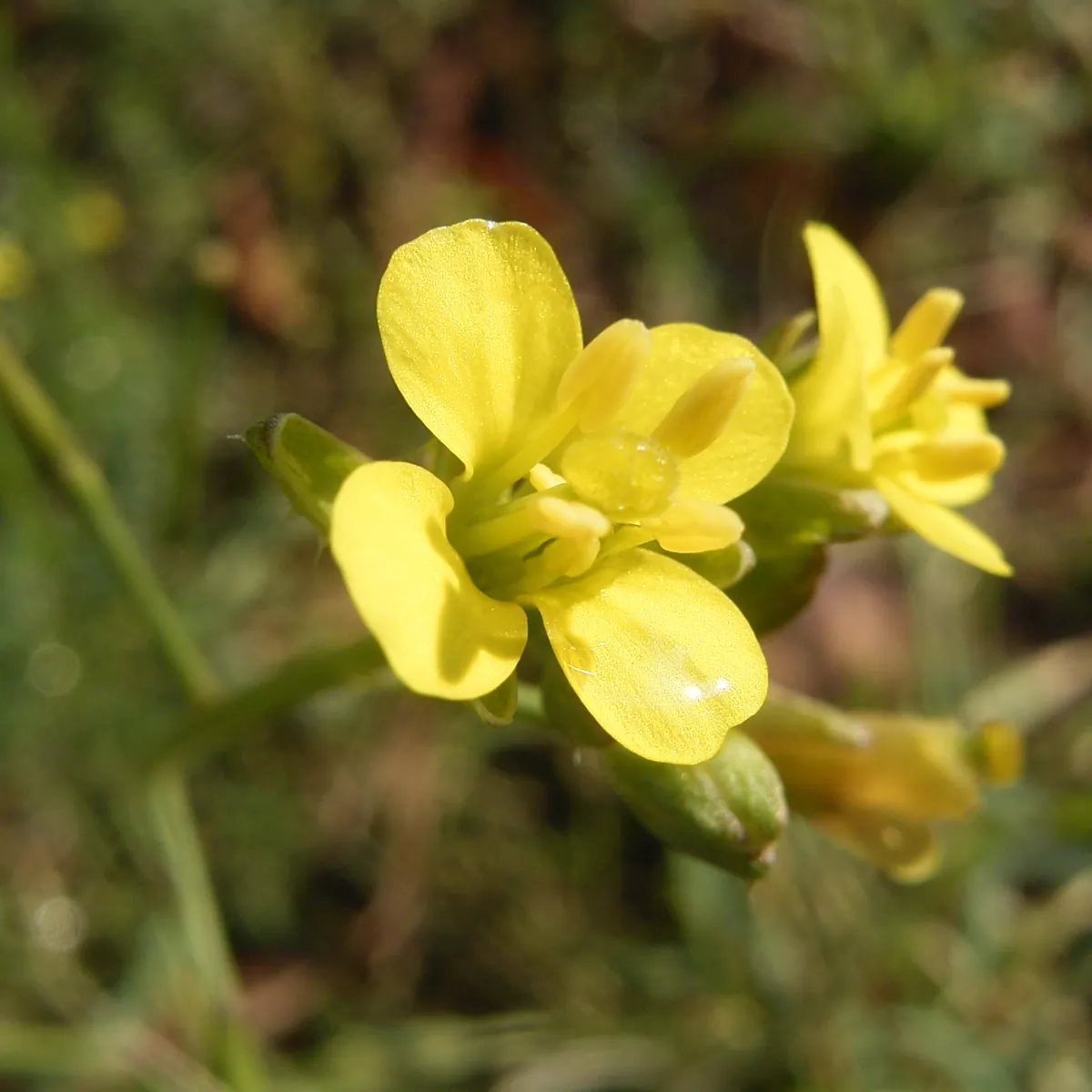
Wild Mustard / Steppe Harra
Diplotaxis harra / Diplotaxis simplex
- Sidi Bouzid
- Kairouan
- Gafsa
- Gabès
- Sfax
- Mountain Honey / Wildflower
- Diplotaxis honey
A very common wild plant in arid and steppe areas, covering vast expanses with a yellow carpet.